THE BLUE ZONE

The Blue Zone I Didn't Know I Was Living In
I found out something today: I live in a Blue Zone.
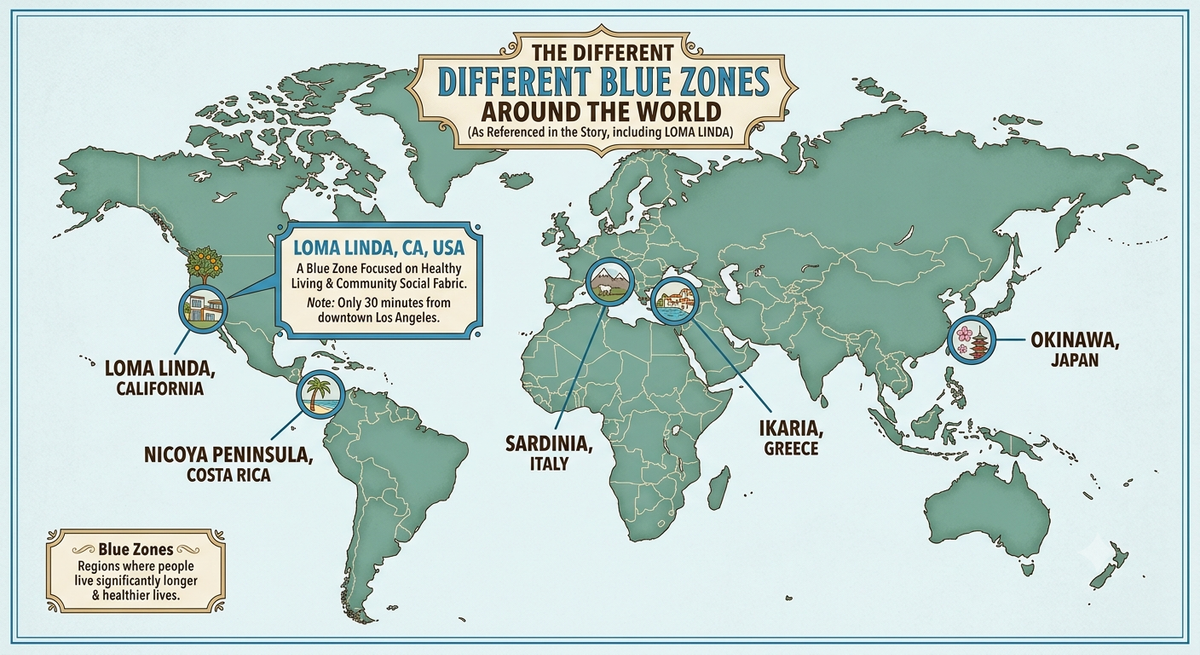
Blue Zones are regions researchers identified as home to some of the longest-lived, healthiest populations on earth. There are only five in the world: Okinawa, Japan; Ikaria, Greece; Sardinia, Italy; Nicoya, Costa Rica; and Loma Linda, California.
I have lived in Loma Linda, and I did not know this. I have not adopted a plant-based diet. I have never sat down with a Seventh-day Adventist and talked faith over dinner. By the numbers, I should not qualify for whatever it is that makes this place different.
And yet today, in the space of a single afternoon, I felt exactly what the researchers have been trying to explain for twenty years.
What Actually Happened Today
I spent over half an hour waiting for fingerprints at a print shop, where a single clerk was working through a packed room. It was the kind of wait that, in most places, produces sighs, phone-checking, and a little simmering resentment in the air.
Instead, there was nothing like that at all. No one complained. No one was short with the clerk, even though we could all see she was doing the work of three people. The people who arrived after me waited even longer than I did, and they were just as patient. Everyone could see what was happening, and everyone extended grace anyway.
Then I went to Trader Joe's. I picked up my organic produce, some chicken, some salmon, and checked out. The clerk was warm and talkative the whole time, the way good Trader Joe's clerks often are. But as I turned to leave, he said something that stopped me: “I appreciate you.”
He didn't say “have a nice day,” and he didn't say “thanks, come again.” He said, “I appreciate you,” and I felt it. It wasn't a script. He meant it.
I am thirty minutes from downtown Los Angeles without traffic, and the emotional distance between that print shop line and that grocery checkout, versus what I'd expect thirty minutes west, felt like it belonged to a different decade.Then, this evening, I went for a walk after 8 p.m., once the sun had started going down and the air had finally cooled off. That was when people were out.
I passed twelve different people enjoying the evening: some walking dogs, some walking with a friend, some walking alone. None of them were walking to get somewhere. They were out simply to enjoy it, and that, too, felt like one more piece of the same magic.
The Research Behind the Feeling
Researchers studying Blue Zones have identified nine common threads across all five regions, something they call the “Power 9.” A few of them include a strong sense of purpose, daily stress relief, stable family and community structures, and deep, lasting social bonds.
Harvard epidemiologist Dr. Walter Willett, who has studied these regions for decades, put it simply: people in Blue Zones aren't doing anything mystical. They're just better at consistently practicing behaviors we already know are tied to a longer, healthier life.
But the piece of his explanation that stopped me was this: Blue Zones are, in his words, places that got “frozen in time.” They were not untouched by modern life, and they did not stay stuck in the past. They were simply slower to be swept up by everything that convenience culture quietly cost us. Cars replaced walking.
Screens replaced neighbors. Processed food replaced the ritual of cooking. It happened almost everywhere, and it happened gradually enough that most of us didn't notice what we were trading away.
Blue Zones simply held onto more of it, and not because they rejected modernity. Loma Linda has smartphones and freeways and grocery delivery like everywhere else. But something about the social fabric here didn't erode at the same rate.
What I Think I Actually Witnessed
I don't think I experienced a “diet” today, and I didn't experience “exercise science.”
What I experienced was trust. I saw a room full of strangers extending patience to an overwhelmed clerk because they could see she was trying. I met a grocery clerk who meant what he said. I have neighbors who still say hi.
That, I think, is the “old” that the researchers are pointing to. It isn't a nostalgia act, and it isn't a diet plan. It is a community that never fully let go of the assumption that the person in front of you deserves patience and kindness, even on an ordinary Tuesday, even when nobody's watching, even when there's no reason to perform it.
I am deeply grateful to be living inside that, even by accident. And I wanted to write this down so that if you ever find yourself in a place like this, whether it's Loma Linda or somewhere of your own, you notice it.
You don't have to be Adventist, and you don't have to eat plant-based. You just have to pay attention to the fact that some places never stopped being kind, and that when you find one, it is worth naming out loud.
Places like this still exist, and I got to spend an afternoon inside one.