Major Watson, I salute you!

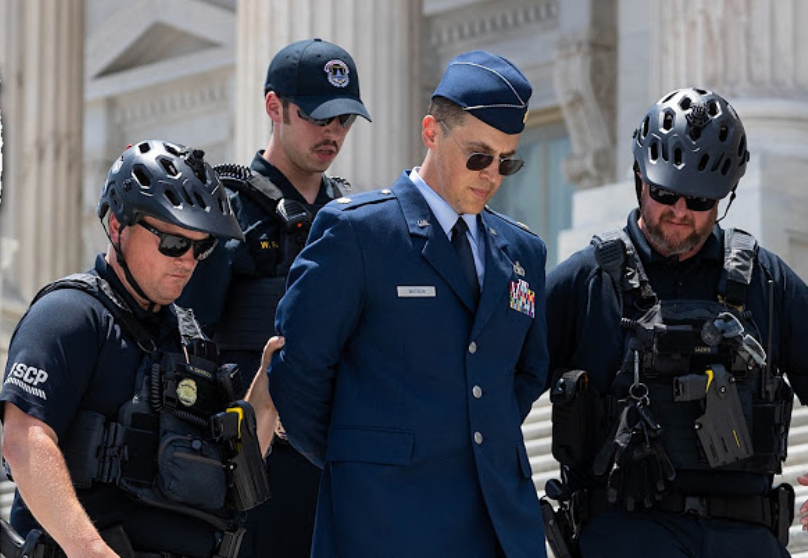
He Chose the Ultimate "Nuclear Option"
Ask yourself a brutal question: Would you throw away your entire life's work for a single sentence?
Would you deliberately destroy a decorated 17-year military career? Would you willingly forfeit the retirement pension you spent nearly two decades earning? Would you risk your family's reputation, subject yourself to public scrutiny, and march directly toward a military prison cell with completely unknown consequences?
Most people wouldn't, but U.S. Air Force Major Jason Watson did.
(A quick note for readers outside the United States: to understand why this moment is being called historic, it helps to understand a piece of the American constitutional system first — so we'll pause the story briefly to explain it, then come back to Watson.)
Giving Up Everything for a Message
When Major Watson walked onto the steps of the U.S. Capitol in full uniform holding a sign demanding the removal of the administration, he wasn't just protesting. He was executing a career suicide mission. He knew the strict rules of the U.S. military's legal code. He knew the Pentagon would launch an immediate investigation. He knew that the moment he refused to step down, his life as he knew it was over.
He gave up absolutely everything he had built since he was a young service member to deliver one urgent warning to the American public.
"What matters far more than who I am is what I have to say and the price I'm willing to pay to say it." — Major Jason Watson
The Constitutional Argument He Was Making
This is the part that non-American readers most need to understand, because it's why Watson believed this sacrifice was necessary.
The U.S. Constitution deliberately splits control over war between two branches of government, so that no single person can drag the country into conflict alone:
- Congress (the elected legislature) holds the exclusive power to formally declare war, fund the military, and authorize prolonged military engagements. This comes from Article I, Section 8 of the Constitution — sometimes called the "Declare War Clause."
- The President is the Commander-in-Chief (Article II) — meaning he directs the armed forces day-to-day and can respond immediately if the country is suddenly attacked. But this authority is meant to be defensive and immediate, not a green light to start new wars on his own.
Watson's argument was that this line had been crossed. In his own words, delivered at a press conference before his arrest:
"When the President of the United States orders military action against foreign countries absent an emergency scenario, where American interests are under imminent, dire threat — as was done with Venezuela, Cuba, and Iran — that's an unconstitutional usurpation of Congress's authority and a violation of the War Powers Clause. These violations resulted in the deaths of 13 service members, and injuries of hundreds more. For this, the president and vice president must be impeached, convicted, and removed."
In plain terms: Watson argued that these strikes weren't defensive responses to an active emergency — they were the President making a unilateral decision to go to war, which the Constitution reserves for Congress alone. To him, that wasn't a policy disagreement. It was a violation of the exact document every service member swears to defend.
Why He Chose the Capitol Steps, Not the Chain of Command
The U.S. military has formal channels for officers who believe a directive is unlawful — reporting through the chain of command or to an independent watchdog office. Watson bypassed all of them. Instead, he stood in uniform, in public, in the one place where the only body with constitutional authority over the President — Congress — would be forced to see him.
That decision is itself part of the story: he didn't just risk his career quietly behind closed doors. He staked it publicly, in the one location built for confronting Congress directly.
Did We Even Hear It?
The real tragedy of this situation isn't just the end of a Major's career — it's the noise surrounding it. In a media landscape dominated by corporate influence, political posturing, and rapid news cycles, Watson's sacrifice risks being swallowed before its meaning fully lands.
He didn't choose a path of violence. He didn't hide behind an anonymous leak. He used his own body, his own uniform, and his own future as the ultimate megaphone to say that the people in charge are no longer representing regular, hard-working Americans.
He paid the ultimate price to make a constitutional argument from the steps of the Capitol. The only question left is: how many people actually understood what he was saying — and how many are still listening?
A Personal Note
I have only seen this one other time in my life, and that was when my own brother, Paul, refused to let an institution create an unsafe and even dangerous environment for the facility's residents and its employees. As he got teary-eyed with a reporter, I knew he was telling the truth. And I believe Major Jason Paul Watson is speaking the truth as well.
My father was in the Air Force and the Army, and my stepfather was a Marine and in the National Guard. Major Watson understood his mission, and he executed it to perfection.
I salute you, Major Watson. Thank you for your service.
Note: this piece reflects one perspective on a contested, ongoing political and legal matter. Major Watson's supporters see an act of principled sacrifice; his critics — including many who value strict military neutrality — see a dangerous breach of civilian control norms. Both views are part of the public conversation around this case.