Communication Lessons from the Cornell 7

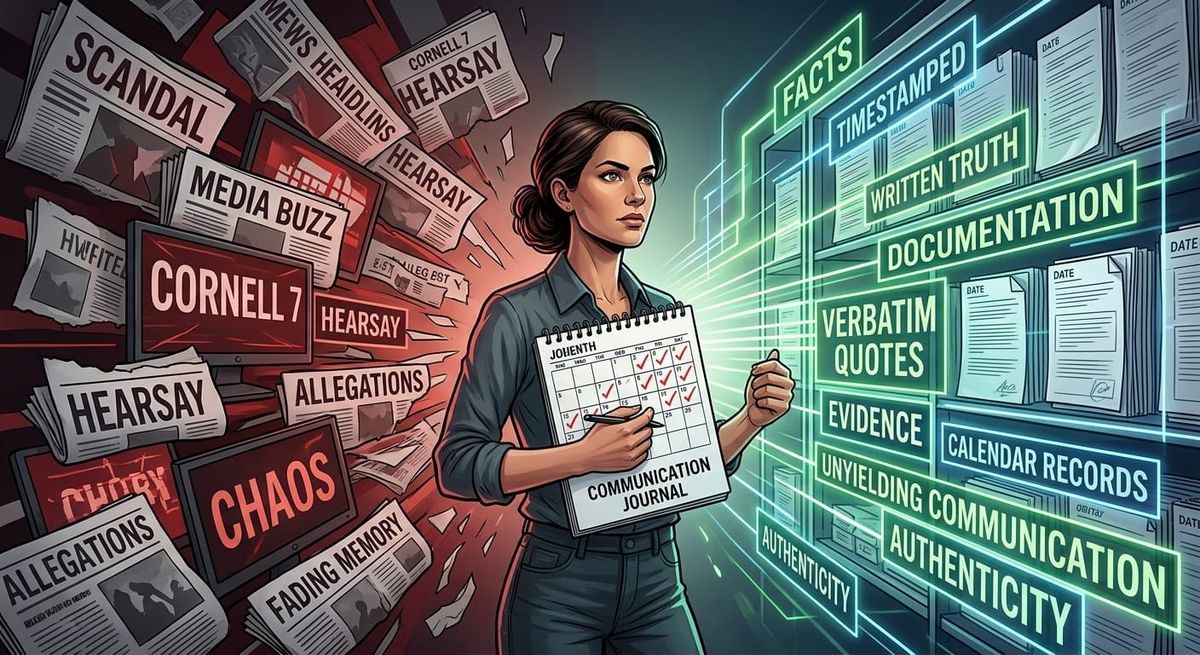
Document Everything
Every time a story like the Cornell 7 dominates the news cycle, public debate defaults to speculation, optics, and competing claims. But strip away the media noise, and any high-stakes crisis ultimately comes down to one core question: What actually happened, and who can communicate the truth?
In moments of immense stress, memory is notoriously unreliable, and narrative control often belongs to whoever speaks loudest. That is why the most critical form of communication during a crisis isn't a press release or a social media post—it’s the quiet habit of real-time written communication.
Learning the Science of the Police Report
I learned the power of keeping notes taken right in the moment long before I ever had to use them myself. Early in my ex-husband’s career on the police force, he couldn't type quickly, and detailed incident reports had to be submitted by the following morning. Late at night, I would sit at the keyboard while he recounted events step-by-step.
I typed the precise dates, exact times, locations, and word-for-word conversations. That experience taught me a fundamental principle of effective communication: an event isn't defined by how you remember it months later, but by how accurately you communicate it in writing while the dust is still settling. In law enforcement, a case rises or falls on the immediate written record.
Putting Theory into Practice: The Custody Calendar
Years later, I found myself facing a high-stakes personal battle—a custody case in court. Remembering what I learned about clear communication from those late-night police reports, I decided to track every single interaction. For three months, I kept a calendar recording every time my step-children’s grandmother attempted to make contact, noting the date, time, and duration of each interaction.
When we arrived in court, she testified under oath that she was never allowed to see her grandchildren.
I handed over three months of methodical, dated records. That simple calendar single-handedly proved the truth and refuted her testimony on the spot. It wasn't my word against hers anymore—it was a solid, undeniable record of factual communication.
How to Document Everything in Real Time
If I could give one piece of advice to "Jane Doe" or anyone else caught in the crosshairs of a major incident, legal dispute, or institutional conflict, it would be this: document everything as it happens. Your private records are your primary tool to communicate your side of the story when it matters most.
Here is how you can use documentation as a powerful communication tool:
- Write It Down Immediately: Don't rely on your memory tomorrow morning or next week. Write down your recollection of the night's events as soon as you are in a safe place so your communication remains accurate.
- Focus on Facts, Not Feelings: Record exact dates, times, specific locations, and who was present. Clear communication sticks to the facts: instead of writing "he was being aggressive," write "at 8:15 PM, he raised his voice and said [exact words]."
- Capture Word-for-Word Quotes: Whenever possible, log verbatim conversations. Direct quotes carry far more weight than general summaries when you need to communicate what took place.
- Preserve Digital Footprints: Save text messages, keep call logs, and send emails to yourself to create automatic, verifiable digital timestamps that support your written communication.
- Keep It Simple and Consistent: You don't need fancy software. A simple physical calendar, a dedicated notebook, or a timestamped notes app on your phone is all it takes to communicate a clear timeline.
The Bottom Line
Media attention eventually shifts, public opinion moves on, and memories fade. But simple, accurate records created in the moment remain permanent. In moments of crisis, the best communicator isn't the loudest voice in the room—it's the paper trail you built while the event was actually happening.