Analyzing a Top-Tier German Executive’s Interview

What 60 Seconds Revealed
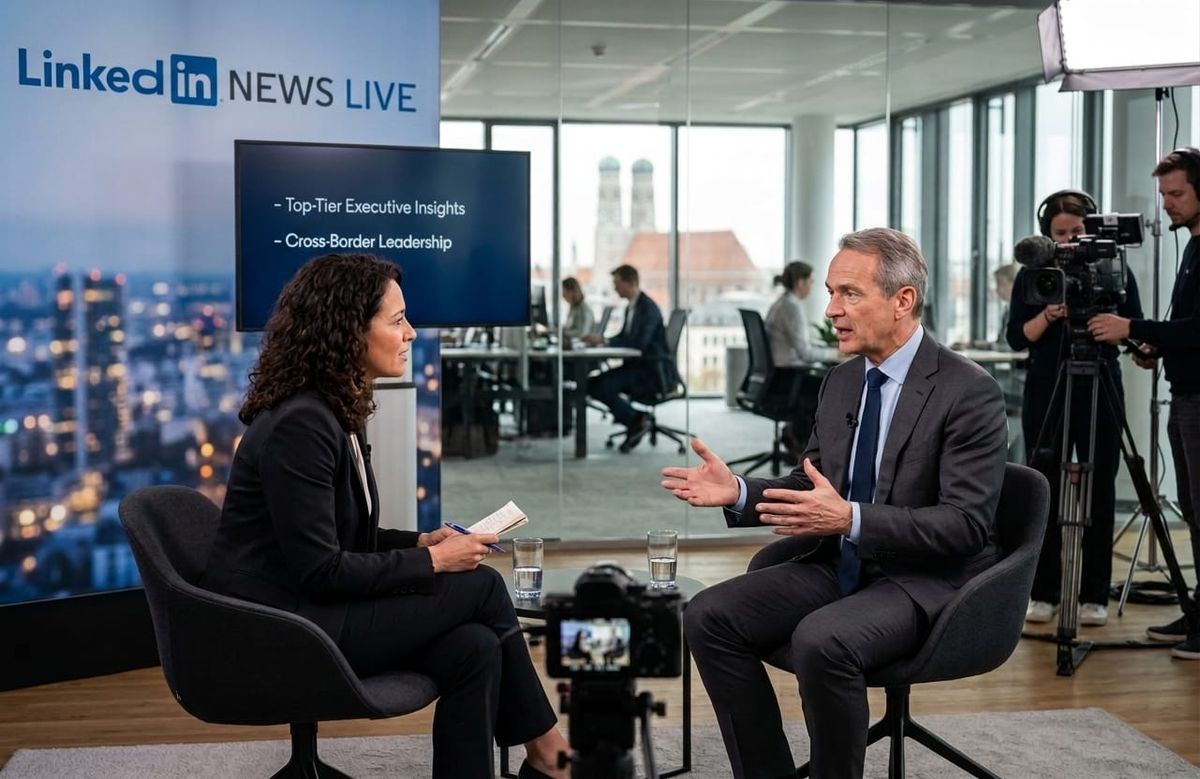
I just got done analyzing an interview featuring a top-tier German executive who leads a $240 billion global enterprise.
Make no mistake: this leader is brilliant. He is doing an incredible job steering a massive multinational powerhouse, and his industry expertise is undeniable. Yet, in a single 60-second clip, a subtle performance gap revealed that even at the absolute peak of corporate success, there is room for improvement.
In just one minute of high-stakes airtime, here is what happened:
- He evaded the core question entirely, replacing a direct binary answer with a rambling operational story.
- He suffered a real-time grammatical collapse, dropping subjects and scattering run-on clauses.
- He relied on vague placeholders, filling his delivery with words like "it came in," "the surprise," and "doing those things" without clear antecedents.
- He managed to say zero substantive points while sounding completely fluent, energetic, and confident.
To the untrained ear, his English sounded smooth. But to an international board, an investor, or a cross-border partner, his strategic authority completely dissolved in real time.
The Phenomenon of Verbal Camouflage
What happened in those 60 seconds isn't a lack of intelligence or English vocabulary. It is Verbal Camouflage—the default defense mechanism non-native executives deploy when cognitive overload strikes under pressure.
Operating in a second language during high-stakes moments forces the brain to manage complex strategic logic while simultaneously assembling English syntax. When stress spikes, working memory collapses. Instinctively, leaders fill the air with high-energy buzzwords to maintain the illusion of momentum, masking the fact that their narrative structure has completely fallen apart.
The Real-World Cost of "Fluency Without Clarity"
In cross-border business, fluency is not clarity.
When C-suite and VP-level leaders experience this structural breakdown during international summits, media appearances, or critical negotiations, the operational cost is massive:
- Strategic direction gets lost in translation.
- International partners lose confidence in execution.
- Direct/indirect communication mismatches stall global deals.
Traditional L&D programs fail to fix this because they treat it as a language problem. It isn't. It is a physiological, cognitive, and structural performance breakdown.
Restoring Command Under Pressure
Eliminating Verbal Camouflage requires moving past standard coaching into an integrated, interdisciplinary framework:
- Neuroscience: Managing real-time cognitive load so working memory stays online when questioned.
- Somatic Anchoring: Preventing the physical urgency to speak before the logical frame is built.
- Executive Presence: Mastering the strategic pause to retain absolute authority over the room.
- Linguistic Precision: Replacing empty filler phrases with surgical, high-impact structural hooks in global business English.
When executive leaders master this synthesis, they stop hiding behind verbal camouflage. They stop just sounding fluent—and start commanding the narrative with absolute precision.
Lisa Courtney is an Intercultural Business Communication Specialist and Founder of The Elephant Method®, an interdisciplinary methodology designed to help non-native executives eliminate performance friction in high-stakes global environments.